 English
 Português
 Tetum
Tetum
Profile
Faculty of Agriculture
Profile
a. To prepare students for entry into professional life with high-level skills in agricultural science and technology.
b. To develop and advance science applied to education, research, and community service.
c. To develop science and technology in the field of agriculture for national development.
d. To conduct learning in education, research, and development of agricultural science and technology to solve current problems in this area.
e. To monitor the state of the environment and its relationship with agriculture in a sustainable and ecological way.
f. To guarantee and support science and technology within the scope of food security.
g. To promote science and technology within the scope of self-sufficiency in national agro-industry and agro-commerce.
f. To educate the human person with respect for God, country, family, neighbor, and the environment.
Vision, Mission & Values
Vision
The Faculty of Agriculture pursues the vision of the National University of Timor-Leste, which is to be the center of reference for Higher Education in Timor-Leste.The Faculty of Agriculture additionally pursues its own vision, which is excellence and leadership in agricultural sciences and technologies.
- The Faculty of Agriculture pursues the vision of the National University of Timor-Leste, which is to be the center of reference for Higher Education in Timor-Leste.
- The Faculty of Agriculture additionally pursues its own vision, which is excellence and leadership in agricultural sciences and technologies.
Mission
The Faculty of Agriculture pursues the mission of:a. Preparing students for entry into professional life with high capacity in agricultural science and technology.b. Developing and advancing science applied to education, research, and community service.c. Developing science and technology in the field of agriculture for national development.d. Conducting learning in education, research, and development of agricultural science and technology to solve current problems in this area.e. Monitoring the state of the environment and its relationship with agriculture in a sustainable and ecological way.f. Guaranteeing and supporting science and technology within the scope of food security.g. Promoting science and technology within the scope of self-sufficiency in national agro-industry and agro-commerce.f. Forming the human person with respect for God, the Fatherland, the Family, one's neighbor, and the environment.
The Faculty of Agriculture pursues the mission of:
a. Preparing students for entry into professional life with high capacity in agricultural science and technology.
b. Developing and advancing science applied to education, research, and community service.
c. Developing science and technology in the field of agriculture for national development.
d. Conducting learning in education, research, and development of agricultural science and technology to solve current problems in this area.
e. Monitoring the state of the environment and its relationship with agriculture in a sustainable and ecological way.
f. Guaranteeing and supporting science and technology within the scope of food security.
g. Promoting science and technology within the scope of self-sufficiency in national agro-industry and agro-commerce.
f. Forming the human person with respect for God, the Fatherland, the Family, one's neighbor, and the environment.
History
The Foundation
The history of higher education in Timor-Leste began during the Indonesian occupation, when on October 1, 1986, the Universitas Timor Timur (UNTIM) was founded by Engineer Mário Viegas Carrascalão, a Timorese national and former Governor of the Province of Timor-Leste, who worked for the United Nations (UN) and was appointed by the Indonesian government.
This private higher education institution focused on training middle managers, agricultural technicians, and pre-secondary and secondary school teachers. It then had four faculties: the Faculty of Agriculture; the Faculty of Social Policy; the Faculty of Education; and the Faculty of Economics and Administration.
The National University of Timor-Leste (UNTL) was the first and only public university in the new country of Timor-Leste, founded on November 17, 2000, as a result of the reorganization and merger of Universitas Timor Timur and Politeknik Dili, under the direction of Rector Armindo Maia. In the merger process, both higher technical education and academic education came to be offered by UNTL.
The Faculty of Agriculture was an organic unit of UNTL, having been founded on the same date as the founding of the National University of Timor-Leste (UNTL). This Faculty is the conversion of Fukultas Pertanian, Universitas Timor-Timur (UNTIM) during the period of Indonesian occupation. The Faculty of Agriculture began with three departments: Agronomy, Agro-Socio-Economics, and Agro-Livestock. In 2010, it created the Department of Animal Health, and in 2017, it created another department, the Department of Fisheries and Marine Sciences, totaling five departments or courses.
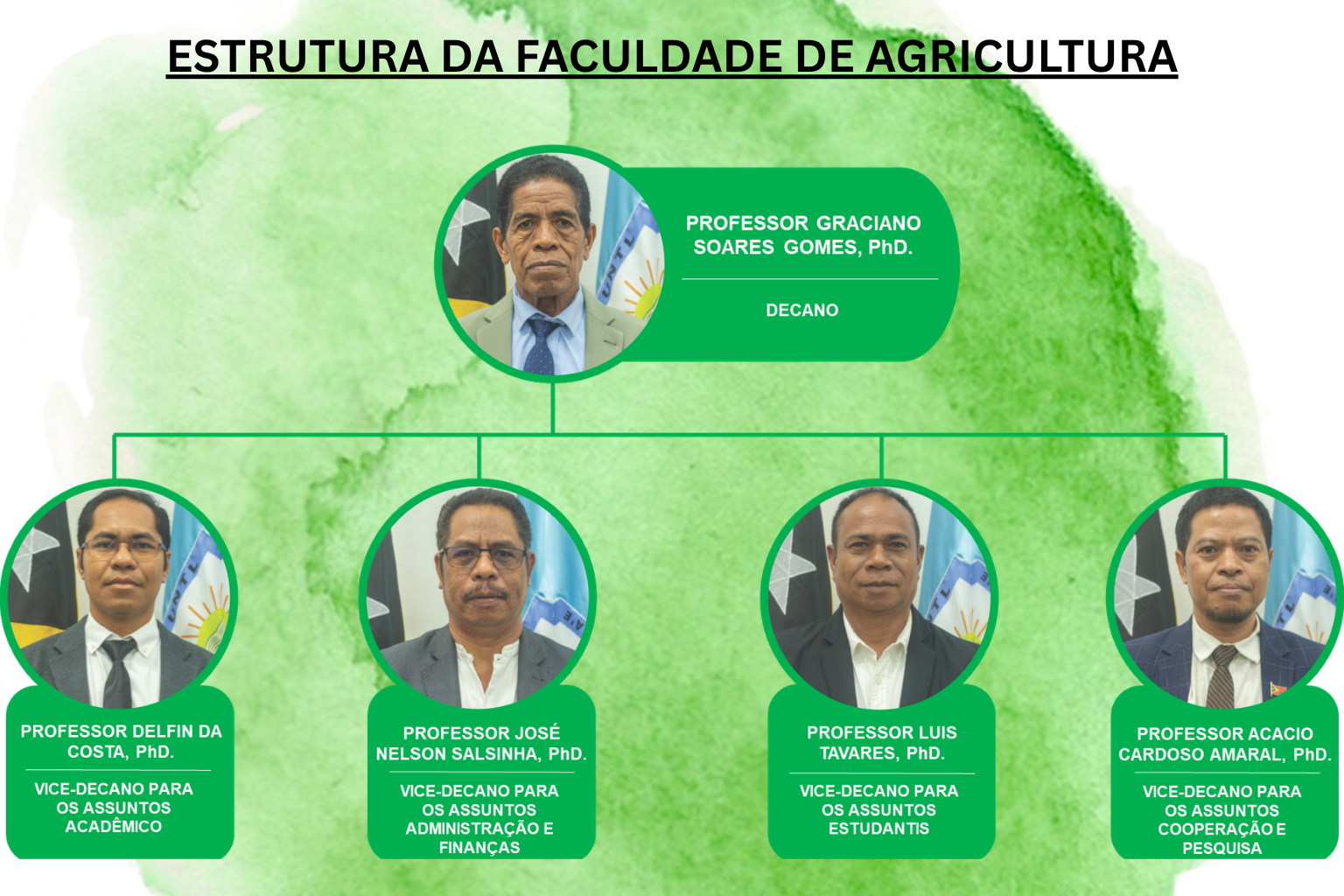
Organizational Structure
Staff Distribution